
Introduction: The Himalayan Temple Nobody Talks About — But Everyone Should Visit
In the vast spiritual geography of Uttarakhand, certain names echo endlessly — Kedarnath, Badrinath, Tungnath, Rishikesh. These are the destinations that fill calendars, booking websites, and travel itineraries. But deep inside the Rudraprayag district, perched alone on a narrow ridge at the summit of Kronch Parvat, sits a temple so dramatically positioned and so spiritually powerful that it stops every visitor in their tracks — yet somehow remains one of the best-kept secrets of the Garhwal Himalayas.
This is the Kartik Swami Temple — and the trek that leads to it is one of the most rewarding short treks in all of northern India.
Dedicated to Lord Kartikeya — the elder son of Lord Shiva, commander of the celestial armies, and a deity widely revered across the Indian subcontinent under names like Murugan, Skanda, Subrahmanya, and Kumara — the Kartik Swami Temple trek is a journey that beautifully blends adventure with devotion. The trail is short enough for beginners, yet the views from the summit are so vast and so dramatic that seasoned Himalayan trekkers rank it among their most memorable experiences.
Standing at the temple on a clear day, you will see a near-complete panorama of the Garhwal Himalayas — Chaukhamba, Kedarnath, Nanda Devi, Trishul, Neelkanth, Bandarpoonch, Dronagiri, and Meru-Sumeru all visible at once. It is the kind of view that makes you feel, for one extraordinary moment, that you can see the entirety of the world.
This guide covers everything — the Kartik Swami Temple trek distance, the starting point, the complete trek route, the time required, the best season to visit, how to reach, what to carry, nearby attractions, accommodation options, and the deep mythology that makes this place spiritually unforgettable.
About Kartik Swami Temple: The Rare Shrine of Lord Kartikeya
The Kartik Swami Temple is located in the Rudraprayag district of Uttarakhand, atop Kronch Parvat (also spelled Kraunch Parvat), at an altitude of approximately 3,048–3,200 metres (10,000–10,400 feet) above sea level.
It is dedicated to Lord Kartikeya — also known as Kartik Swami, Murugan, Skanda, Subramanya, Kumara, and Karthikeyan depending on the region of India. Lord Kartikeya is one of the most significant deities in Hinduism, particularly revered in South India, Sri Lanka, Singapore, and Malaysia. In the northern Himalayas, however, temples dedicated to Kartikeya are extraordinarily rare — making the Kartik Swami Temple one of the most unique and spiritually significant shrines in the entire country.
The temple is believed to be the only temple in Uttarakhand exclusively dedicated to Lord Kartikeya, which immediately sets it apart from the hundreds of Shiva temples that define the religious landscape of the Garhwal and Kumaon regions.
The site is referenced in the ancient Skanda Purana — one of the 18 major Puranas of Hinduism, and the text most closely associated with the mythology of Lord Kartikeya (Skanda). According to the Purana, Kronch Parvat (this very mountain) is the sacred spot where Lord Kartikeya meditated following a legendary dispute with his brother and father. The Skanda Purana describes this location as one of the most spiritually charged places in the Himalayan region.
What Is Unique About This Temple?
The Kartik Swami Temple has several features that make it unlike virtually any other Himalayan temple:
No Conventional Idol: Unlike most temples that house sculpted or cast metal idols of the deity, the sanctum sanctorum of the Kartik Swami Temple houses a naturally formed image of Lord Kartikeya on a marble-like stone — believed to be the actual bones of the deity himself, offered as an act of supreme devotion and renunciation. This gives the temple an extraordinary spiritual gravity — a raw, unmediated encounter with the divine.
360-Degree Himalayan Views: The temple sits on a narrow ridge with open sky on all sides. The views are not just scenic — they are genuinely staggering. On a clear day, no other vantage point in the Rudraprayag district offers a broader panorama of the central Himalayan peaks.
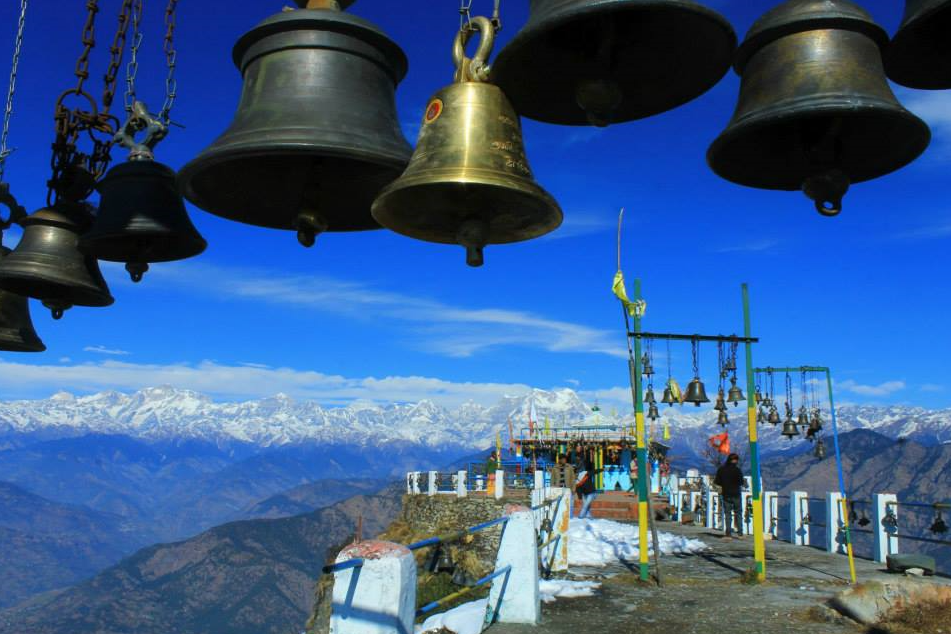
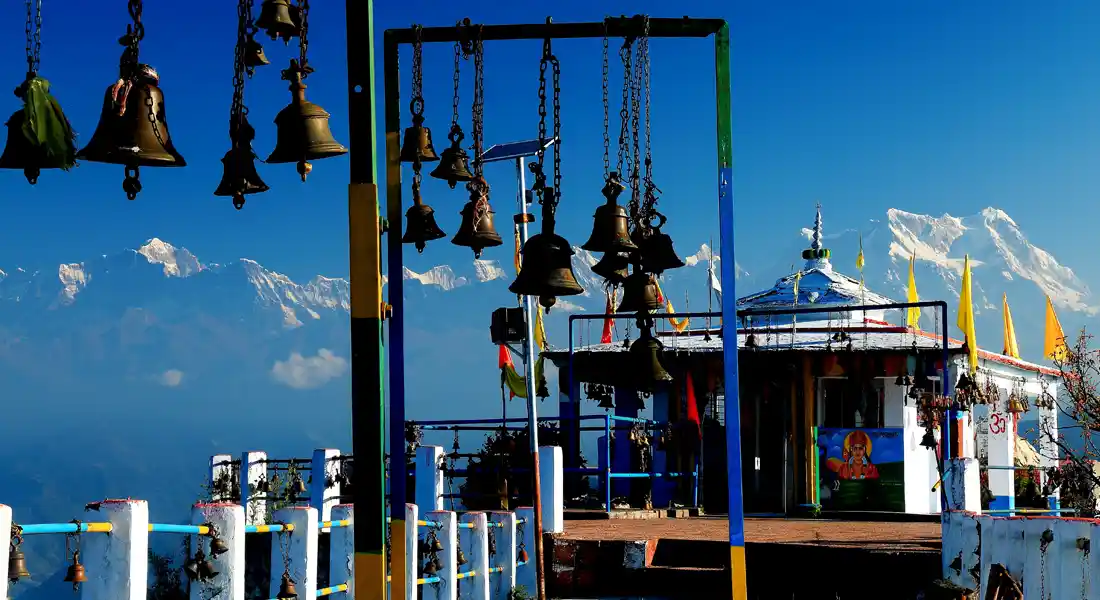
Thousands of Bells: Devotees who come to the temple offer bells as a vow to Lord Kartikeya, believing that the deity fulfills the wishes of sincere devotees. Over the years, thousands of bells have been hung around the temple, creating a remarkable, music-filled atmosphere every time the mountain wind picks up. The sound of hundreds of bells ringing together against a Himalayan backdrop is one of the most memorable sensory experiences a temple can offer.
Spiritual Significance for Both North and South India: Because Lord Kartikeya (Murugan) is the primary deity of Tamil Nadu and Kerala, the Kartik Swami Temple attracts a uniquely diverse group of devotees — pilgrims from South India frequently make the long journey to Uttarakhand specifically to visit this rare northern shrine of their beloved deity.
The Mythology Behind the Temple: A Story of Devotion and Renunciation
To truly appreciate the Kartik Swami Temple trek, one must understand the profound legend that gave rise to it — a story that speaks to themes of sibling rivalry, parental favoritism, and the most extreme form of devotional sacrifice imaginable.
According to Hindu mythology, Lord Shiva once posed a challenge to his two sons: Kartikeya and Ganesha. He declared that whichever son first completed seven rounds of the entire universe would receive the privilege of being worshipped first in all rituals — a divine honor of enormous significance.
Lord Kartikeya, ever the warrior and adventurer, immediately mounted his divine vehicle — the peacock — and set off to circumnavigate the cosmos. He was confident. He was fast. He was determined.
Lord Ganesha, rotund and unhurried, simply walked in seven circles around his parents — Lord Shiva and Goddess Parvati — and declared with gentle wisdom: “You are my entire universe. To go around you is to go around all of creation.”
Lord Shiva, deeply moved by Ganesha’s wisdom and devotion, declared Ganesha the winner. He also proclaimed that henceforth, Ganesha would be worshipped first before any other deity in every ritual and ceremony — a tradition that continues in Hinduism to this day.
When Lord Kartikeya returned from his cosmic journey and learned what had happened, he was overcome with grief, anger, and a profound sense of injustice. Rather than accepting the decision with equanimity, he was consumed by the pain of perceived rejection. In a dramatic act of grief and devotion, Kartikeya renounced his physical form — offering his flesh to his mother Parvati, and his bones to his father Shiva.
He then departed from Kailash in his skeletal form and arrived at this remote Himalayan peak — Kronch Parvat — where he meditated in supreme asceticism and eventually merged with the divine. It is believed that the bones of Lord Kartikeya are enshrined within the sacred stone idol inside the temple, making this not merely a place of worship but literally the physical remains of a god.
This mythology gives the Kartik Swami Temple an emotional and spiritual depth that few pilgrimage sites can match. This is not a place where a god simply blessed a king or defeated a demon. This is the place where a god suffered, renounced, and transformed — making it a site of extraordinary power for devotees seeking spiritual transformation of their own.
Kartik Swami Temple Trek: Complete Details at a Glance
| Detail | Information |
|---|---|
| Location | Rudraprayag District, Uttarakhand |
| Altitude | ~3,048–3,200 metres (10,000–10,400 ft) |
| Trek Starting Point | Kanakchauri Village |
| Kartik Swami Temple Trek Distance | 3 km one way (6 km round trip) |
| Kartik Swami Temple Trek Time | 1.5–3 hours one way (ascent) |
| Difficulty Level | Easy to Moderate |
| Entry Fee | ₹10 for locals; nominal fee for tourists |
| Best Time to Visit | March–June and September–November |
| Nearest Town | Rudraprayag (~40 km from Kanakchauri) |
| Nearest Railway Station | Haridwar Railway Station (~205 km) |
| Nearest Airport | Jolly Grant Airport, Dehradun (~222 km) |
| Temple Open | Year-round |
Kartik Swami Temple Trek Starting Point: Kanakchauri Village
The Kartik Swami Temple trek starting point is Kanakchauri Village — a small, quiet, and traditional Garhwali hamlet located in the Rudraprayag district of Uttarakhand, approximately 40 km from Rudraprayag town on the Rudraprayag–Pokhari road.
Kanakchauri is where all road connectivity ends and the trail begins. The village sits at a comfortable altitude, offering the last opportunity to eat, rest, use proper facilities, and purchase any last-minute supplies before the ascent. It is a genuinely charming village — traditional stone and wood houses, terraced agricultural fields, and the kind of warm, unhurried hospitality that the Garhwal region is famous for.
Facilities at the Starting Point
- Tea stalls and small eateries at Kanakchauri are available for a quick meal or hot beverage before or after the trek
- Small guesthouses and homestays are available for overnight stays
- A newly built eco-lodge with bamboo huts and modern facilities has been established in the village
- Basic public toilet facilities are available near the trailhead
- A small Shiva temple at the base of the final climb serves as a natural rest point before the last ascent
It is advisable to reach Kanakchauri by mid-morning at the latest to begin the Kartik Swami Temple trek comfortably, complete darshan, and descend before evening. Starting the trek from Kanakchauri by 9:00–10:00 AM is ideal.
Kartik Swami Temple Trek Distance: How Far Is It?
The Kartik Swami Temple trek distance is 3 kilometres one way from Kanakchauri Village to the temple at the summit of Kronch Parvat. The complete round trip distance is 6 kilometres.
This makes the Kartik Swami trek one of the shortest high-altitude temple treks in Uttarakhand — a significant advantage for pilgrims who may not have extensive trekking experience or fitness, but who still wish to experience the grandeur of a genuine Himalayan temple at altitude.
However, the Kartik Swami Temple trek km figure can be slightly misleading. While 3 km is indeed a modest distance by trekking standards, the trail involves:
- A consistent uphill gradient throughout, with no flat sections after leaving the village
- A final section of approximately 80–380 steep stone steps (estimates vary depending on the source, but the stairs are a well-known feature of the last approach)
- Sections of narrow rocky path requiring careful foot placement
- The cumulative effect of altitude at the summit (~3,000+ metres), which slows progress and increases effort for those arriving from the plains
As a result, while the trek is absolutely appropriate for beginners and first-time trekkers, it should not be underestimated. Taking your time, staying hydrated, and stopping to rest at the many beautiful viewpoints along the trail is the right approach.
Kartik Swami Temple Trek Route: Step by Step
The Kartik Swami Temple trek route is straightforward and well-defined. There is essentially one primary path from Kanakchauri to the temple, making navigation easy even without a guide.
The Trail in Detail
From Kanakchauri Village → Lower Forest Section (0–1 km)
The trail begins right at the edge of Kanakchauri Village, initially following stone-paved steps through the settlement itself. Beyond the village boundary, the path enters a dense forest of rhododendron, oak, and deodar trees. In March and April, this section is transformed into a spectacular natural display as the rhododendrons burst into blazing red, pink, and white blooms — covering the forest in a carpet of colour that is one of the most beautiful natural sights in Uttarakhand.
The forest trail is shaded and relatively gentle in gradient at this stage. Birdsong fills the air — this section is particularly rich in Himalayan birdlife, with over 150 recorded species in the Kartik Swami area. Keep your eyes open for the vivid Himalayan Monal (Uttarakhand’s state bird), woodpeckers, and various species of eagles circling overhead.
Middle Forest and Open Terrain (1–2 km)
As the trail continues upward, the forest begins to thin and occasional clearings reveal the first dramatic views of the surrounding Himalayan peaks. On clear days, the Chaukhamba massif appears first — four enormous peaks of the Gangotri group, gleaming white against the blue sky. The Kedarnath range and Kedarnath Dome become visible to the north. This is where most trekkers pause, catch their breath, and realize exactly what kind of views they have committed to climbing toward.
The gradient increases noticeably in this section. The path narrows and becomes more rocky. Prayer flags begin to appear, tied to trees and stones by previous pilgrims, creating a visual tapestry of colour against the green-grey of the forest.
Final Ascent — Stone Steps and Ridge (2–3 km)
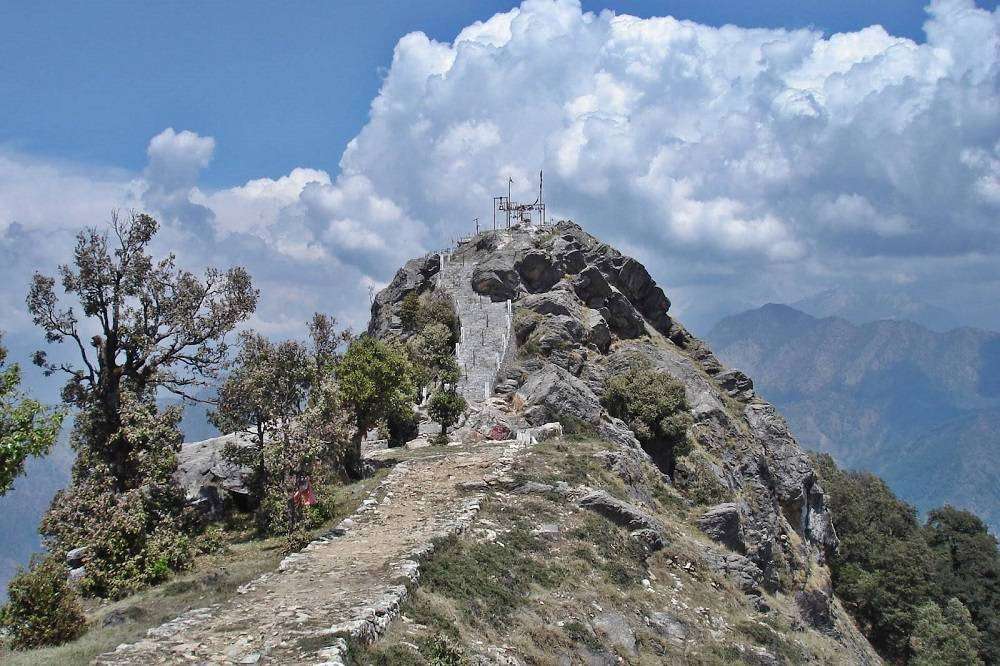
The final kilometre of the Kartik Swami Temple trek route is the most dramatic and the most demanding. The trail approaches the narrow ridge on which Kronch Parvat sits, and the stone steps begin — wide at first, then narrowing as they climb the ridge face directly. On either side of the ridge, deep valleys drop away dramatically — creating the sensation of climbing a stairway suspended in mid-air between sky and valley.
A small Shiva temple appears near the base of the final staircase — a natural waypoint for a rest, a brief prayer, and the gathering of resolve for the last push.
The 80+ steep stone steps that form the final section of the approach are the most physically demanding part of the entire trek. They rise steeply, the air is notably thinner at this altitude, and the exertion is real. But with each step, the panorama behind you expands — until, at the summit, it explodes into a full 360-degree view of the Garhwal Himalaya that makes every gasping breath completely worthwhile.
At the Summit: Kartik Swami Temple
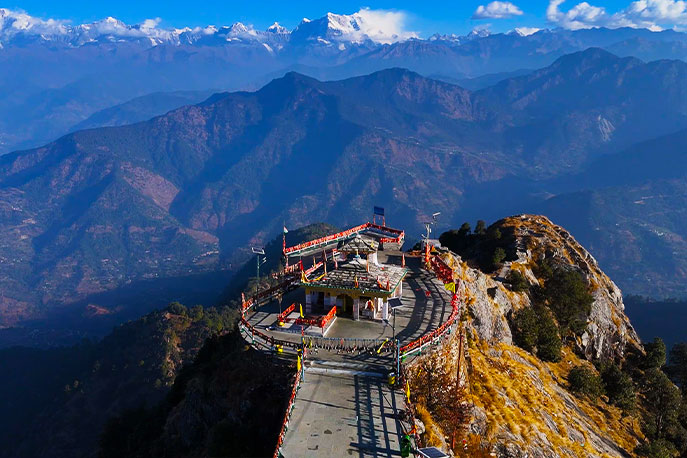
The temple complex at the summit of Kronch Parvat is modest in scale but magnificent in atmosphere. The main temple houses the sacred naturally-formed stone idol of Lord Kartikeya. Hundreds — perhaps thousands — of bells hang from every available structure, ringing constantly in the mountain breeze. The sound is ethereal and deeply meditative.
Surrounding the main temple are smaller shrines, including representations of Lord Kartikeya’s peacock vehicle (vahana) and various associated deities. The temple priests (pujaris) perform regular aarti and puja, and the scent of incense mingles with the cold mountain air.
And then — the view. Standing at the Kartik Swami Temple, you can see simultaneously:
- Chaukhamba (massif of four peaks, visible directly to the north)
- Kedarnath Dome and the Kedar group of peaks
- Neelkanth (the sacred blue-throated peak above Badrinath)
- Trishul (Lord Shiva’s trident peak)
- Nanda Devi — at 7,816 metres, the second highest peak in India
- Dronagiri and Nanda Ghunti
- Bandarpoonch (to the west)
- Meru and Sumeru Parvat
This is one of the broadest panoramic views available from any easily accessible point in the entire Rudraprayag district — and it is entirely free of charge, requiring only a 3 km walk and the will to show up.
Kartik Swami Temple Trek Time: How Long Does It Take?
The Kartik Swami Temple trek time varies based on fitness level, pace, and the number of stops taken for photographs, rest, and prayer. Here is a practical breakdown:
Ascent (Kanakchauri to Temple):
- Fit, fast walkers: 1 to 1.5 hours
- Average trekkers: 2 to 2.5 hours
- Leisurely pace / beginners / families: 2.5 to 3 hours
At the Temple:
- Darshan, puja, and time to absorb the views: 30 minutes to 1.5 hours (as long as you wish)
Descent (Temple to Kanakchauri):
- Most trekkers: 1 to 1.5 hours (descents are typically 30–40% faster)
Total Kartik Swami Temple trek time (round trip including temple visit):
- Minimum (quick visit): approximately 3 to 3.5 hours
- Comfortable visit: 4 to 5 hours
- Leisurely visit with extended temple time: 5 to 6 hours
The Kartik Swami Temple trek km distance of 6 km round trip and the time estimates above confirm that this is genuinely one of Uttarakhand’s most accessible high-altitude temple experiences. An early start from Rudraprayag (7:00–8:00 AM), a 40 km drive to Kanakchauri, and beginning the trek by 9:00–10:00 AM will see most visitors complete the journey, spend meaningful time at the temple, and return to Kanakchauri by 2:00–3:00 PM — a perfectly manageable day trip.
Best Time to Visit Kartik Swami Temple Trek
The Kartik Swami Temple is open throughout the year, which is a significant advantage over many Himalayan temples that close during winter. However, the trekking experience varies considerably by season.
March to June — Spring and Early Summer (Highly Recommended)
This is arguably the best period for the Kartik Swami temple trek. March and April offer the spectacular rhododendron bloom — the forests along the trail are ablaze with red and pink flowers, creating one of the most photogenic trekking environments in Uttarakhand. Temperatures are pleasant — daytime temperatures of 15°C–25°C make for comfortable trekking. The sky is often clear, giving sharp mountain views.
May and June remain excellent though slightly warmer at lower altitudes. The Kalash Yatra — an important annual festival at the temple organized by the temple committee — takes place in May or June. During this event, an 11-day Mahayagya (grand fire ceremony) is performed, and on the 10th day, devotees collect sacred water from a nearby spring that mysteriously flows only during this specific ceremony — believed by locals to be a divine miracle. Witnessing the Kalash Yatra is a truly rare and moving experience.
July to August — Monsoon Season (Use Caution)
The monsoon transforms the entire region into deep, lush greenery. The forests and meadows are extraordinarily vivid during this period, and the mist and clouds that drift through Kronch Parvat give the temple an otherworldly, floating-in-the-clouds atmosphere.
However, the trails become muddy, and the stone steps can be extremely slippery in rain. Landslides occasionally affect the road to Kanakchauri. For experienced trekkers with proper waterproof gear, the monsoon visit is hauntingly beautiful. For beginners or those with limited trekking experience, it is advisable to wait for the post-monsoon season.
September to November — Autumn Season (Also Excellent)
Post-monsoon Uttarakhand is a revelation. The air becomes crystal clear, the forests turn golden and amber, and the views of the Himalayan peaks become sharper than at any other time of year. The Kartik Purnima festival (full moon in the month of Kartik, usually October–November) is the most important annual festival at the Kartik Swami Temple — devotees from across the country, including large numbers from South India, make the pilgrimage to the temple during this period.
Temperatures are cooling by October but remain trekking-friendly during the day. Nights at the base can be cold, requiring warm layers.
December to February — Winter (Cold but Accessible)
Unlike many high-altitude Himalayan destinations, the road to Kanakchauri and the Kartik Swami temple trek route remain accessible through the winter months in most years. The trail may be covered in snow, which adds a dramatic beauty to the experience but requires proper footwear with grip.
Winter views of the snow-capped peaks from the temple are spectacular and unobstructed. The temple is open, but visitors are sparse — giving a rare sense of having one of Uttarakhand’s finest viewpoints entirely to yourself.
How to Reach the Kartik Swami Temple Trek Starting Point
The Kartik Swami Temple trek starting point — Kanakchauri Village — is located on the Rudraprayag–Pokhari route, approximately 40 km from Rudraprayag town.
From Haridwar / Rishikesh (Most Common Route)
Step 1: Take a bus or shared taxi from Haridwar/Rishikesh to Rudraprayag (approximately 140 km; 5–6 hours by road). Buses are available throughout the day from both cities.
Step 2: From Rudraprayag, take a shared jeep toward Pokhari — ask to be dropped at Kanakchauri (approximately 40 km; 1.5–2 hours). Shared jeeps charge around ₹50–80 per person. Private taxis from Rudraprayag to Kanakchauri are also available for around ₹500–700.
Step 3: Begin the Kartik Swami Temple trek from Kanakchauri.
From Chopta / Tungnath / Kedarnath Side
For travellers completing a Rudraprayag circuit and combining Kartik Swami with Chopta-Tungnath or Ukhimath:
- From Chopta: Drive to Chandrapuri via Ukhimath, then continue to Kanakchauri (~75 km, approximately 2.5–3 hours)
- From Ukhimath: Drive to Banswara → Mohankhal → Kanakchauri (~50 km)
- From Kedarnath side (Guptkashi): Drive via Rudraprayag to Kanakchauri (~60–70 km)
The flexibility of the Kartik Swami Temple’s location makes it an ideal addition to any Kedarnath–Chopta–Panch Kedar itinerary in the Rudraprayag–Chamoli region.
Nearest Railway Station
Haridwar Railway Station is the most convenient railhead — approximately 205 km from Kanakchauri. Well-connected to Delhi, Mumbai, Jaipur, Kolkata, and other major cities. From Haridwar, proceed by bus or taxi to Rudraprayag.
Rishikesh Railway Station is also an option, approximately 210 km from Kanakchauri.
Nearest Airport
Jolly Grant Airport, Dehradun — approximately 222 km from Kanakchauri. Regular flights from Delhi (45 minutes). From the airport, take a taxi to Rishikesh (~30 km), then connect by bus or taxi to Rudraprayag and onwards to Kanakchauri.
Trek Route Alternatives: Chopta to Kartik Swami
Beyond the standard Kanakchauri starting point, there exists a longer alternate route approaching the Kartik Swami Temple from the Chopta side. This is a less trodden path, suitable for experienced trekkers who wish to combine the Tungnath-Chandrashila trek with a journey to Kartik Swami as part of a multi-day Garhwal Himalaya circuit.
The Chopta to Kartik Swami route traverses forested ridgelines and remote trails that see very little human traffic, passing through a landscape of exceptional natural beauty. This route requires a local guide and is not suitable for casual visitors or beginners, but for adventure trekkers seeking Uttarakhand’s most unpublicized trails, it represents an extraordinary opportunity.
What to See and Do at Kartik Swami Temple
Temple Darshan and Puja The primary experience is the sacred darshan of the naturally formed idol of Lord Kartikeya inside the temple. The morning and evening aarti (prayer ceremonies) are particularly atmospheric — temple priests perform rituals as the sound of bells and mantras fills the mountain air. Devotees are welcome to participate in the puja.
The Bell Offering Ritual A deeply meaningful ritual at the Kartik Swami Temple involves offering a bell as a vow — devotees believe that Lord Kartikeya fulfills the sincere wishes of those who make this offering. The temple is festooned with thousands of bells accumulated over the years, each one a physical manifestation of someone’s hope, prayer, or gratitude.
Sunrise and Sunset Views The ridge position of the Kartik Swami Temple makes it one of the finest sunrise and sunset viewpoints in the Rudraprayag district. For those who spend the night at Kanakchauri, beginning the trek before dawn to watch the sun rise over the Himalayan peaks from the temple summit is an experience described by many visitors as one of the most profound moments of their travels.
Bird Watching The Kartik Swami area is home to over 150 species of birds — including the Golden Eagle, Steppe Eagle, Black Eagle, Bearded Vulture, Himalayan Snowcock, and the magnificent Himalayan Monal Pheasant. For birdwatchers, the forest section of the trek is particularly rewarding.
Camping near Kanakchauri The area around Kanakchauri and the nearby village of Mohankhal offers excellent camping. Spending a night under the Himalayan stars — with the outline of snow peaks visible against the dark sky — is an experience that transforms a simple day trek into a complete mountain adventure. Camp costs are approximately ₹1,000–₹1,500 per night.
Kanakchauri Village Exploration The village itself is worth exploring — traditional Garhwali architecture, local temples (including the Nagnath and Bhairav temples within the village), and interactions with the warm, welcoming local community offer a genuine window into rural Uttarakhand life that most tourists never see.
Kalash Yatra (May/June) If your visit coincides with the annual Kalash Yatra, attending this 11-day festival is a rare opportunity to witness traditional Garhwali religious ritual at its most vivid and authentic. The miraculous spring that flows only during this ceremony is particularly fascinating.
Flora and Fauna Along the Kartik Swami Temple Trek Route
The Kartik Swami Temple trek passes through a diverse ecological landscape that makes the journey beautiful at every stage.
Flora:
- Rhododendron trees — the trail’s most celebrated natural feature; peak bloom in March-April creates a spectacular display of crimson, pink, and white flowers
- Deodar cedar and blue pine — the towering conifers that form the forest’s backbone
- Oak trees — providing shade and a distinctive green canopy
- Alpine herbs and medicinal plants — the Garhwal Himalayas are one of India’s richest repositories of Ayurvedic plant species; many grow naturally along this trail
- Wildflowers — including primulas, potentillas, and various alpine blooms in summer
Fauna:
- Himalayan Monal — Uttarakhand’s state bird; brilliantly coloured and frequently spotted on this trail
- Barking Deer (Muntjac) — shy and elusive but occasionally seen in the forest sections
- Himalayan Langur — groups of these long-tailed grey monkeys are commonly encountered along the trail
- Eagles and Vultures — large raptors circle the ridgeline regularly
- Himalayan Snowcock — spotted at higher altitudes
- Numerous butterfly species — particularly abundant in spring and summer
The entire region falls within or near the Kedarnath Wildlife Sanctuary — one of the largest protected areas in the western Himalayas.
Accommodation Options Near Kartik Swami Temple Trek
At Kanakchauri Village (Trek Starting Point):
- Mayadeep Holiday Home — one of the oldest and most established budget-friendly accommodation options near the trailhead; known for reliable, honest service
- Eco-lodge with bamboo huts — a newer establishment offering basic but comfortable accommodation with modern facilities, located in close proximity to the village
- Local homestays — several village families offer simple but warm accommodation; staying in a homestay is highly recommended for a culturally immersive experience
- Ashrams near the temple — a couple of simple ashrams managed by local priests offer basic shelter; visitors must carry their own groceries and supplies
At Rudraprayag (40 km from trek): Rudraprayag town offers a wider range of budget to mid-range hotels, making it a convenient base for combining the Kartik Swami trek with visits to other nearby sites like the Rudraprayag confluence (Alaknanda and Mandakini rivers) and the Koteshwar Mahadev Cave Temple.
Camping near Kanakchauri / Mohankhal: Camping in the area costs approximately ₹1,000–₹1,500 per night. This is the preferred option for those wishing to experience the full Himalayan atmosphere — particularly for sunrise views from the temple summit.
Essential Packing List for the Kartik Swami Temple Trek
Despite the relatively short Kartik Swami Temple trek distance of just 6 km round trip, packing correctly is important for a comfortable experience at high altitude.
Clothing:
- Comfortable trekking shoes or sturdy sports shoes with good grip (the stone steps can be slippery)
- Full-length trekking trousers
- Moisture-wicking t-shirts (2)
- Light fleece or woollen sweater (temperatures at the summit are significantly cooler than at the base)
- Warm jacket or windcheater (essential for the summit visit, even in summer)
- Rain jacket or poncho (especially during and after monsoon)
- Warm cap and light gloves (for winter/early spring/late autumn visits)
- Comfortable socks (wool or synthetic, not cotton)
Gear:
- Small daypack (15–20 litres is sufficient)
- Reusable water bottle (minimum 1.5 litres)
- Trekking pole (optional but helpful for the steep descent)
- Sunglasses and sunscreen (UV intensity is high at altitude)
- Headlamp (if starting before dawn for sunrise)
Supplies:
- Light snacks — dry fruits, energy bars, biscuits, chocolate
- Sufficient water or water purification tablets
- Sufficient cash (no ATMs near Kanakchauri; withdraw at Rudraprayag)
- Basic first aid — band-aids, pain relief tablet, ORS sachets
For Temple:
- A small offering for the puja (flowers, prasad, incense)
- Warm inner layers that can be removed when inside the temple
Nearby Attractions: Combining Kartik Swami with a Larger Rudraprayag Circuit
The Kartik Swami Temple’s location in the Rudraprayag district makes it an ideal component of a broader Garhwal Himalaya itinerary.
Chopta and Tungnath Temple (~75 km from Kanakchauri) The famous Chopta–Tungnath–Chandrashila circuit is the crown jewel of Rudraprayag district trekking. Tungnath is the world’s highest Shiva temple at 3,680 metres. Combining Kartik Swami and Tungnath in a 3–4 day itinerary gives you two extraordinary Himalayan temple experiences for the price of a single trip.
Ukhimath (~30 km from Kanakchauri) The winter seat of the Kedarnath temple deity. The Omkareshwar Temple in Ukhimath houses the idols of Kedarnath, Madhyamaheshwar, and other Panch Kedar deities during the winter months. A visit is particularly meaningful for Shiva devotees.
Rudraprayag Confluence The sacred Sangam (confluence) of the Alaknanda and Mandakini rivers at Rudraprayag town is a significant pilgrimage point. The evening aarti at the confluence, performed at the Chamunda Devi Temple, is a serene and moving experience.
Koteshwar Mahadev Cave Temple Located 3 km from Rudraprayag town on the banks of the Alaknanda River, this cave temple of Lord Shiva is embedded in a cliff face and offers a dramatically atmospheric setting for darshan.
Dhari Devi Temple Located on the drive between Rudraprayag and Srinagar, this unique Goddess Kali temple sits on a rock in the middle of the Alaknanda River. The deity is believed to change appearance from a young girl in the morning to a mature woman at midday and an old woman by evening — a phenomenon of deep religious significance.
Deoria Tal (Deoria Lake) A stunning high-altitude lake approximately 50 km from Kanakchauri, accessible via a 2–3 km trek from Sari Village. The lake offers mesmerizing reflections of the Chaukhamba peaks in its still surface — one of Uttarakhand’s most iconic photographic subjects.
Practical Tips for the Kartik Swami Temple Trek
- Start early. Begin the trek by 9:00–10:00 AM at the latest to ensure you complete the round trip before afternoon weather changes or reduced visibility.
- Wear the right footwear. The stone steps on the final section of the Kartik Swami Temple trek route can be extremely slippery when wet or frosty. Shoes with good grip are essential — avoid sandals or smooth-soled footwear.
- Carry water. There is no reliable water source on the trail between Kanakchauri and the temple. Carry at least 1.5 litres from the starting point.
- Withdraw cash in Rudraprayag. There are no ATMs at or near Kanakchauri. Stock up on cash before leaving Rudraprayag.
- Acclimatize if coming from the plains. If you are arriving from a low-altitude city and going straight to the trek, spend at least a few hours in Rudraprayag or Kanakchauri before beginning the ascent.
- Avoid monsoon if you are a beginner. The stone steps become treacherous in wet weather. If visiting during July–August, go only if you have appropriate footwear and trekking experience.
- Don’t rush at the summit. The views from the Kartik Swami Temple are extraordinary — give yourself at least 30–45 minutes at the top to absorb the panorama, visit the temple properly, and experience the unique atmosphere of the bell-covered ridge.
- Respect the temple customs. Remove footwear before entering the sanctum, dress modestly, and maintain the quiet, respectful atmosphere of an active place of worship.
- Combine with nearby sites. The Kartik Swami Temple trek is only 3 km — plan a 2–3 day itinerary that includes Rudraprayag, Kartik Swami, Ukhimath, and optionally Chopta-Tungnath to make the most of your Uttarakhand journey.
- Carry a camera (or charge your phone). The views from this ridge are among the finest available from any accessible point in the Rudraprayag district. You will want to photograph them.
Frequently Asked Questions (FAQs)
Q: What is the Kartik Swami Temple trek distance? A: The Kartik Swami Temple trek distance is 3 km one way from Kanakchauri Village, making it 6 km round trip. It is one of the shortest high-altitude temple treks in Uttarakhand.
Q: What is the Kartik Swami Temple trek starting point? A: The Kartik Swami Temple trek starting point is Kanakchauri Village, located approximately 40 km from Rudraprayag on the Rudraprayag–Pokhari road in Uttarakhand.
Q: How many km is the Kartik Swami Temple trek? A: The Kartik Swami Temple trek km total is 6 km for the complete round trip (3 km ascent + 3 km descent).
Q: How long does the Kartik Swami Temple trek take? A: The Kartik Swami Temple trek time is approximately 1.5 to 3 hours for the ascent depending on pace, and 1 to 1.5 hours for the descent. Including time at the temple, expect the full round trip to take 4 to 5 hours.
Q: What is the best time to visit the Kartik Swami Temple? A: The best time is March to June (rhododendron bloom, clear skies) and September to November (post-monsoon clarity, Kartik Purnima festival). The temple is open year-round.
Q: Is the Kartik Swami Temple trek suitable for beginners? A: Yes. The trek is rated Easy to Moderate and is suitable for beginners with basic fitness. The 3 km trail is manageable, though the final steep steps require some effort.
Q: What is the Kartik Swami Temple trek route? A: The Kartik Swami Temple trek route follows a single well-marked path from Kanakchauri Village through rhododendron and oak forests, up a rocky ridgeline, and then via 80+ steep stone steps to the temple at the summit of Kronch Parvat.
Q: Is there an entry fee for the Kartik Swami Temple trek? A: Since June 2024, the Forest Department has introduced a nominal entry fee: ₹10 for locals and slightly higher for visitors from outside the region.
Q: Can I visit Kartik Swami Temple in winter? A: Yes — unlike many Himalayan temples, Kartik Swami Temple remains accessible in winter. The road to Kanakchauri typically remains open, and while the trail may have snow, it can be trekked with appropriate footwear. Winter views of snow-covered peaks are spectacular.
Conclusion: A Trek That Earns Its Views
There are some temples you visit by taking a bus, buying a ticket, and joining a queue. And then there are temples you earn — through effort, altitude, and a willingness to leave the comfort of the valley behind.
The Kartik Swami Temple trek belongs firmly to the second category. Yes, it is only 3 km. Yes, the time required is just a few hours. But those 3 km of uphill forest path and stone steps lead you to a ridge-top sanctuary that delivers views, silence, and spiritual depth that many far longer treks fail to match.
Lord Kartikeya chose this place — Kronch Parvat — for a reason. Standing here, with the entire Garhwal Himalaya laid out before you and the sound of thousands of bells ringing in the mountain wind, it is not difficult to understand why.
The Kartik Swami Temple trek starting point at Kanakchauri Village is easy to reach. The Kartik Swami Temple trek distance of 3 km is manageable for almost anyone. The Kartik Swami Temple trek time of a few hours demands little from your schedule. What it gives back — in views, in silence, in the rare experience of worshipping at one of India’s most unique and powerful temples — is entirely out of proportion to the effort required.
Go. Start early. Climb the steps. Let the bells ring. And look out at the mountains.
Have you trekked to the Kartik Swami Temple? Share your experience in the comments below, and pass this guide on to any traveller planning a visit to Uttarakhand’s most underrated Himalayan shrine!